The Return of the Sweets
THIS IS A WORK OF FICTION
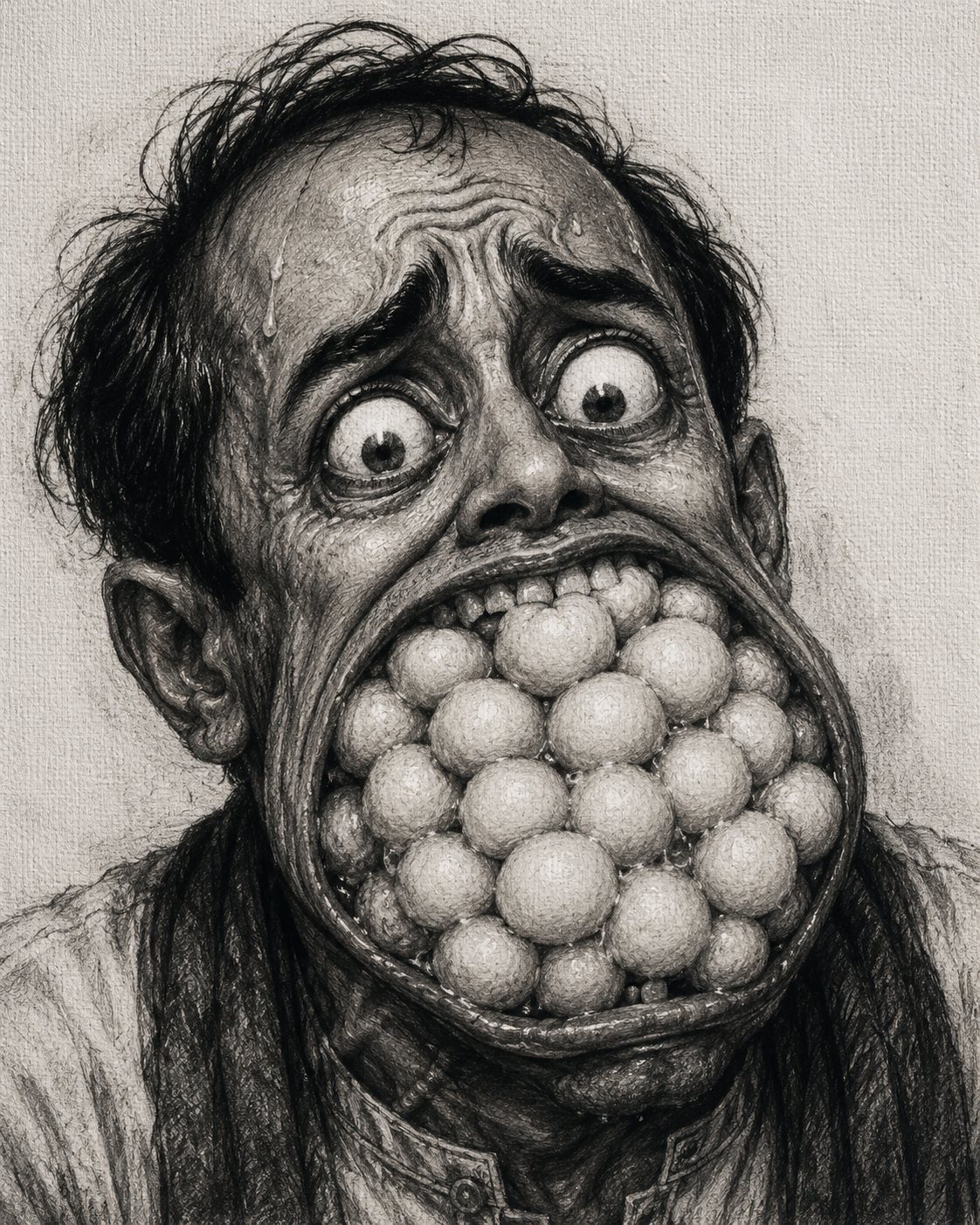
The rosogolla was soft, but the thing that pushed up after it was softer, and his mouth was suddenly crowded.
He had eaten one. His tongue, moving in panic, counted twelve.
Amit spat them into his palm. They were perfect. Warm. Dimpled. They sat in a small pile, gleaming in the fluorescent light of the sweet shop, and they smelled not of cardamom or rosewater but of his own breath, his own sour jet-lag sweat, the inside of his own cheek. He had bitten down once. Now he held a dozen.
The shopkeeper did not look surprised. He only reached past the glass counter and turned the deadbolt on the door. The lock clicked like a dry throat clearing.
“Don’t waste them,” the old man said. His voice was wet. He wore a white vest stained yellow at the armpits. “Your father never wasted them.”
Amit’s father had died three days ago. The cremation was yesterday. Amit was supposed to be asleep in his hotel near the airport, but the room smelled of mildew and his own failure to cry, so he had walked through the monsoon-thick midnight to find something cool and soft to put in his mouth. The heat outside was a blanket, wet and woolen, pressing against his skin even at two in the morning. He had passed sleeping dogs and closed tea stalls, the smell of the river hanging in the air like a warning, until he saw the neon tube above this shop flickering blue and pink. He had chosen it because it was open, and because the air conditioning leaked a thin trail of cool air onto the sidewalk.
He wanted to sleep. That was all. He wanted to close his eyes in a room that did not feel like a lung, and wake up in Newark, where his wife and daughter were not speaking to him because he had missed his daughter’s birthday to fly to Calcutta for a man he had not visited in nine years.
He wanted to sleep. Now he held twelve warm spheres that had been born inside his own head.
“What is this?” Amit said. His tongue felt thick. The empty space in his mouth where the first rosogolla had been was already filling again. He felt a pressure behind his lower gums, a stretching, like a yawn that would not end.
The shopkeeper did not answer. He opened a door behind the counter. The back room smelled of boiled milk and something else, something meaty and sweet, like a bakery built in a slaughterhouse. The air was warm and wet, tropical, and Amit’s glasses fogged. There was a bathtub. It was not empty. It was full of syrup, a thick, pale liquid that moved slowly, and in it floated hundreds of rosogollas, and something else—something pale and long, like a limb, or a root. The root twitched. A drop of syrup fell from it onto the tile, and the tile hissed softly.
On the wall were photographs. Men in white shirts, standing in front of this same shop. They looked like Amit. The same sagging chin, the same wide forehead. The last photo showed a man so thin his shirt hung like a curtain. His mouth was open in a smile, and his teeth were white, and his tongue was not pink but a pale, dimpled white.
“Your father came here every Tuesday,” the shopkeeper said. “He was the inventor. He wanted to make a sweet that never ran out. A sweet that could follow his children. He missed you.”
Amit turned to run. The shopkeeper did not stop him. The old man only said, “Don’t go near the drains. They like water.”
Amit ran into the street. Bagbazar at two in the morning was wet and dark, the pavement black with recent rain. His stomach gurgled. Not with digestion. With a sound like small fists knocking on a door. He needed a toilet. He found a public urinal near the metro station, a concrete block with a broken door, and he locked himself in the stall and pulled down his trousers.
He did not defecate. He delivered.
They came out whole, warm, perfect, landing in the bowl with soft plops. One. Two. Twelve. They floated, white and gleaming, in the filthy water, and they smelled of syrup and shit and something else, something that made Amit’s eyes water with recognition. They smelled of his father’s cologne, the cheap one he had worn since Amit was a child, the one that smelled like lemons and dust.
Amit flushed. The water rose. The rosogollas did not go down. They multiplied. The bowl filled with them, a dozen becoming two dozen, pressing against the porcelain, and Amit backed out of the stall, pulling up his trousers, and he ran again.
He ran back to his hotel. The lobby was empty. The elevator was broken. He climbed four flights of stairs, his heart hammering, his mouth filling again, the pressure behind his teeth constant now. He locked the door of his room. He went to the bathroom. He turned on the tap. He looked in the mirror.
His tongue was white. Not with plaque. With small, round bumps. They were budding at the back of his throat, visible when he said “Ah,” his voice trembling. He reached in with a finger and touched one. It was soft. It pulsed. He pressed harder, and it burst, releasing a warm, sweet fluid that tasted of milk and copper. He gagged. He brushed his teeth. The toothpaste foamed pink. He spat. The foam gathered in the sink, congealed, and became three small spheres, no bigger than peas, but growing.
He called his sister. Mira. She lived in Salt Lake.
“Mira,” he said. “Did Dad ever send you sweets?”
“Every month,” she said. Her voice was far away, dreamy. “A tin box. They were so soft. I ate them all, Amit. I ate them in one sitting. Why?”
Amit looked at his own tongue in the mirror. The bumps were larger now. “Do you feel full?”
“Always,” Mira said. “It’s nice. Like he’s here. Like I’m not alone in the house. I sent a box to your wife. Did she get it?”
Amit’s hand shook. “When?”
“Last month. For your daughter’s birthday. She said they were strange. She said they kept coming.”
Amit hung up. He understood. His sister was already a garden. His wife and daughter were already seeded. His father had been planting them for months.
He went to his father’s apartment. It was empty now, the furniture covered in sheets, but the air was still thick with the smell of old books and tobacco. Amit went to the bedroom. In the closet, behind the winter sweaters his father had never needed in Calcutta, he found a tin box. Inside was a notebook. The pages were soft with humidity, the ink blurred, but the handwriting was his father’s—precise, angry, small.
“The culture requires a host. Familial tissue is best. The cells remember. The cells want to be together. I have engineered them to be palatable. Sweet. They will travel. They will find my son. My daughter. They will never be alone again.”
A photo fell from the back cover. It showed his father standing in the sweet shop, mouth open, tongue extended. The tongue was not a tongue. It was a cluster of rosogollas, small and white, growing from the root of his mouth. The date on the photo was last Thursday. His father had died on Friday. But the man in the photo was already half-sweet.
Amit’s phone buzzed. His wife. He answered.
“Are you on the plane?” she asked. Her voice was distant, clean, American. “Amit, I need to tell you. Those sweets your sister sent. I ate one. Then there were twelve. I thought I was going crazy. I threw them away. They came back. They’re in the fridge now. They won’t stop.”
Amit tried to speak. His mouth was full. He felt them budding behind his teeth, pushing up from the soft palate, rolling forward. He chewed them reflexively, swallowed, and felt them root in his esophagus.
“Amit?” his wife said.
He hung up. He looked in the mirror above his father’s dresser. His face was doughy. His eyes were milky, the pupils almost white. He opened his mouth. A rosogolla rolled out onto his lip, balanced there, and he saw it clearly in the glass. It had a mark on it. A brown spot. His father had had a mole on his lower lip. The rosogolla had it too.
Amit understood. His father had not died. He had dissolved. He had cultured himself into a colony of sweets, a biological recipe that used his own son’s tissue to rebuild itself, to travel, to follow Amit to America. The funeral had been a closed casket because there was nothing inside but syrup-stained sheets. The father was here, now, in Amit’s mouth, his stomach, his blood. He was being rebuilt, dimple by dimple, in a body that could board a plane.
Amit wanted to scream. Instead, he burped, and the sound was muffled by the dozen that filled his throat.
He went to the airport. He did not know why. Maybe he thought he could outrun it. Maybe the colony wanted to go home, and it was steering him now. The airport was crowded even at dawn, families sleeping on the floor, the smell of chai and sweat. He walked through security. The guards did not stop him. He looked normal enough, just a middle-aged man with a stomachache, his eyes red from sleeplessness. He boarded the flight to Newark. He sat in 34B. The man next to him was already asleep. Amit wanted water. The flight attendant gave him a cup. He drank. The water tasted like syrup.
The plane took off. The pressure change squeezed his sinuses, and he felt something shift in his upper jaw, a soft release, a budding. He closed his eyes. He slept. For the first time in days, he slept, and he dreamed of his father’s apartment, but the walls were made of soft, white flesh, and the windows were dimpled, and his father sat in the corner, feeding him something white and warm, saying, “Eat. Multiply. Stay.” When he woke, the plane was over the Atlantic, and the man in 34A was staring at him.
“You were chewing,” the man said. “In your sleep. Loudly.”
Amit’s mouth was full. He nodded. He went to the bathroom. He locked the door. He looked in the mirror. The face was his. The face was his father’s. The difference was only a matter of time, and they had twelve hours of flight left. He touched his cheek. The skin was soft, yielding, like dough left to rise. He pressed, and it dimpled, and the dimple did not spring back.
Amit opened his mouth. He did not spit. He reached in with two fingers, carefully, and extracted them one by one. They came loose with a soft, wet pop, like a kiss breaking. They were warm, heavier than they should be, and they left his gums bleeding slightly, a thin, sweet fluid that was not quite blood. He placed them in the plastic bag the duty-free liquor had come in. Twelve. Then he reached in again. Twelve more. He kept reaching. His jaw ached. His fingers were slick. The bag filled, and then a second bag, and he did not stop because he knew now that he was not emptying himself. He was packing.
The flight attendant knocked. “Sir? Are you alright?”
Amit looked at the bags. They bulged, white and perfect, marked with the faint brown spots of his father’s lip, the texture of his own gums. He thought of his daughter, who would not speak to him. He thought of his wife, who had asked if he was on the plane. He thought of the sweet shop in Bagbazar, the bathtub of syrup, the photographs of men who looked like him.
He opened the door. He smiled. His mouth was full, but he managed to speak around the softness, the pressure, the sweet, familial crowding.
“I brought something from Calcutta,” he said. “Fresh. They multiply.”
He held out the bag. The flight attendant looked down. The rosogollas in the plastic were dimpled and white, and in the fluorescent light of the cabin, they seemed to move slightly, to breathe, to wait for the next mouth, the next body, the next home.
Amit sat down. He fastened his seatbelt. He closed his eyes. The man in 34A was eating chicken. Amit smelled nothing. His own breath, his own skin, smelled of boiled milk and sugar. He was the meal now.
He was not going to sleep. He was going to be delivered. And somewhere in the dark, wet hollow of his own skull, something soft and fatherly pushed up against the bone, budding, multiplying, already planning the return trip.